
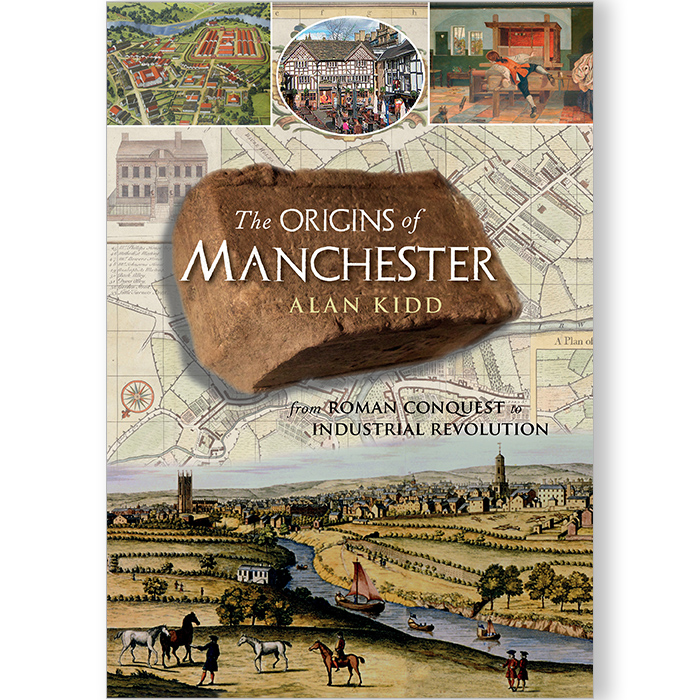
Description
This fascinating book, by a leading historian of the city, tells Manchester’s story from the Romans to the first steam-powered factories, showing how the centuries before the Industrial Revolution formed the foundation for the city’s later greatness.
- From rich merchants and the slave trade to the food riots of the poor
- From how people lived and worked to how the town was governed
- From sanitation and disease to leisure and entertainment
- From buildings and maps to ideas and beliefs
- From uprisings against the Romans to street battles in the English Civil War
The Origins of Manchester is highly readable, scholarly, well illustrated and wide-ranging. It is certain to appeal to anyone with an interest in this great city.
Alan Kidd is Professor Emeritus at Manchester Metropolitan University. He has published numerous articles and books on the history of Manchester.
- Author: Alan Kidd
- Imprint: Carnegie Publishing
- ISBN: 978-1-85936-239-6
- Binding: paperback
- Format: 240 x 170 mm
- Extent: 128 pages
- Illustrations: 60+
- Publication date: 28 April 2023

Steve Collins –
As Alan Kidd points out in the Preface to this book, it is coming up to 30 years since his well-known history, Manchester, was first published. In it, he took 1780 as its starting point and traced the development of the first industrial city to the twenty-first century, a process necessitating regular new editions. This book neatly dovetails into that by beginning with Roman times and taking 1780 as its final destination.
The book is divided into five sections or chapters, the first four being strictly chronological, while the last, ‘Living in eighteenth century Manchester’, tackles a period which has been under-represented in the plethora of historical writing about the city. We open with ‘Mamucium: a Roman fort’, which looks at the area, c.2,000 years ago, ‘where the Medlock flows into the Irwell in what is now Castlefield’, and an artist’s impression of this fort and settlement (based on advice from Norman Redhead) graces the title page. Towns like Mamucium ‘were not planned but instead developed haphazardly over time in response to need.’ As well as garrisons, ‘they also acted as market places where local farmers sold their produce and traders dealt in manufactured wares.’ In fact, so settled did the town become, that Kidd ventures to speculate that ‘Mamucium was probably regarded as a peaceful posting for the Roman military’.
In the next section: ‘Mamecestre: a medieval market town’, it becomes apparent that there are questions about the exact location of the medieval town: whether it was on the site of the Roman settlement, or higher, near the present Cathedral and Chetham’s School of Music. Be that as it may, by the thirteenth century, the town was still small compared with Preston, Lancaster, Liverpool and Wigan. Power at this time was centred on the manor house and the parish church, particularly the latter in this case, and the development of the town’s parish church to collegiate and finally cathedral status, is one abiding and unifying feature of this book.
The central section of the book concentrates on the massive expansion of the town’s population during the early modern period, and more precisely, 1543-1660. Kidd outlines some of the historical methodology, the resources available to historians to enable them to estimate population size and growth. Various forms of source material are listed, for example ‘wills and inventories as well as official documents and state papers for the era’ The date 1543 refers to lay subsidy returns which ‘suggest that in the mid-sixteenth century, the population of the township of Manchester consisted of about 2,000 souls’. During the period covered by this central chapter, the figure doubled and Kidd goes on to make the point that, ‘despite the impact of war and plague … in 1660 Manchester was easily the largest and most populous town in Lancashire.’
The period 1660-1780 saw the roots of the industrial revolution form and take hold, and the author charts the rise and rise of Manchester in the forefront of this development. The population truly exploded during this period and with it the increase in importance of the town. The author analyses the details of this change and concludes that Manchester became ‘the conduit through which the textile districts of North West England connected and interacted with the national economy’, though he points out that ‘the precise reasons why Manchester achieved this status are still debated. There is no clear consensus on why this particular town was so important’. Kidd continues and develops this debate and examines the growth of the cotton trade and its effect on the social and economic success of the town. The question of the slave trade with reference to the town’s industrialisation is necessarily raised and extensively discussed in the section ‘Manchester, cotton and slavery’. This leads to the question of ‘what kind of town was Manchester becoming?’ which introduces the closing chapter of the book. We are made aware of the uneven distribution of wealth in the prosperous and ever-increasing urban sprawl; we see examples of opulent and wealthy lifestyles contrasted with food riots and strikes. Under the headings ‘Culture, leisure and society’ and ‘Politics, religion and authority’, a town of contrasts and divisions is brought into sharp focus with the Jacobite Rebellion of 1745. But these divisions were put aside and ‘by the second half of the eighteenth century, Manchester had become a provincial centre of the very first rank, already attracting fascinated interest for its urban growth, commercial life and transport innovations’, ready to emerge as ‘the first industrial city and a global symbol of the urban industrial revolution.’
The publisher’s ‘blurb’ on the back cover of the book – not always a reliable source of information – uses the words: ‘highly readable’ and ‘scholarly’. These two qualities are not always compatible, but in this case they are entirely accurate and Professor Kidd has once again managed to walk the tightrope between the academic and the accessible and produced a book which should be a necessary addition to the shelves of any reader who has more than a passing interest in the history of Manchester.
Finally, a word should be said about the many illustrations, which are superb throughout. The vast majority are in colour and feature notable buildings, especially Chetham’s Library, and the Cathedral (including fascinating details of some of the misericords), plus various maps and portraits of key figures. The production values are high, resulting in a top-quality book at a reasonable price.
– Steve Collins, Transactions of the Lancashire and Cheshire Antiquarian Society, Vol. 114 (2023)
Stephen Rydzkowski –
Originally published in North West Labour History Society Journal no.50.
What an interesting and informative little book this is. It takes us back to the time of the Romans in Manchester, goes through the ages and ends with Manchester in the eighteenth century. There are plenty of photos and maps illustrating each chapter to accompany and compliment the text which adds to the easy accessibility.
One definite plus is the use of location references to present day Manchester so that the reader knows where the author is referring to and so helps aid visualisation. For example, the Roman Fort of Manchester was located in the area covered by the current railway viaduct linking modern day Deansgate and Oxford Road stations. In a similar vein, few people probably know that Manchester had a castle, albeit a wooden structured one. Well, it did, and it stood where Chethams school of music stands today.
The book is comprehensive in its coverage. It includes things such as the importance of the Chetham and Booth families whose names, facilities and charities remain to this day, the origins of the separation of Salford and Manchester which lie in the Norman Conquest, and, as the centuries progressed, poor relief and the plague, culture and leisure, cotton and the slave trade, population growth and food riots and strikes.
The reference to the system of local government, with its lack of corporation status until the nineteenth century, and this having a positive impact in attracting trade and business to Manchester, is also of interest in helping to understand its economic development. This shows that Manchester was a boom town even before the cotton mills arrived.
However, the two events that warrant specific reference in the book are those of the Civil War and the Jacobite Rebellion. With regard to the Civil War, Manchester was the only major town in the county not held by Royalists. In 1642, there was an attempt by the Royalists to take the town that was repelled. After this, Manchester became the parliamentarian headquarters for the county for the rest of the war.
With regard to the Jacobite rebellion, Manchester was the only place in England to raise a regiment of soldiers to fight in support of their cause in 1745. This was done when Bonnie Prince Charlie stayed in Manchester in November 1745 en route south. However, following their decision to retreat north a few weeks later their next visit to Manchester was met with hostility. The outcome of all this was that Manchester was then subject to military occupation, for showing initial support, for eighteen months.
The book ends with a Notes and Reference section for each chapter. This gives the reader plenty of source material to expand their knowledge of any of the chosen times and themes covered.
All in all, the book is a first-rate contribution to the origins of Manchester, its development and emergence as one of the major towns in England, ready to play a full part in the Industrial Revolution that was to come. It will be of great interest to residents and non-residents alike.